
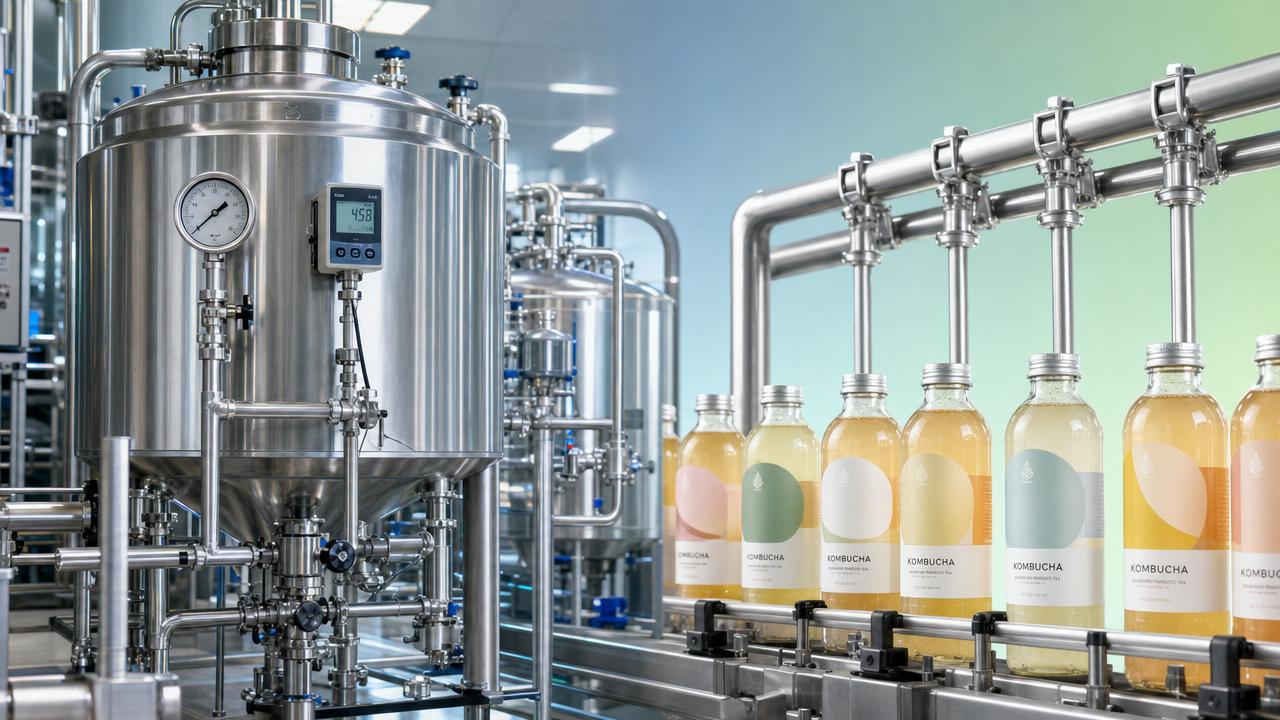
Kombucha Brew Safety Mistakes: What Quality and Safety Managers Must Control
A safe Kombucha Brew depends on more than a good recipe—it requires disciplined process control, hygienic equipment design, and consistent monitoring at every stage.
For quality control and safety managers, small mistakes in sanitation, fermentation parameters, carbonation, or packaging can quickly lead to contamination risks.
Those risks may become product instability, customer complaints, recalls, regulatory pressure, and long-term brand damage if they are not prevented early.
This article highlights the most common kombucha brewing safety mistakes and explains how professional systems, SOPs, and preventive checks reduce avoidable failures.
Why Kombucha Brew Safety Requires More Than Traditional Brewing Experience
Kombucha is not beer, and treating it like beer creates unnecessary safety gaps. Its acidity, sugar profile, microbes, and oxygen exposure behave differently.
A commercial Kombucha Brew usually involves tea extraction, sweetening, cooling, inoculation, primary fermentation, flavoring, carbonation, packaging, and refrigerated or ambient distribution.
Each step changes the risk profile. A safe process must control biological hazards, chemical residues, physical contamination, pressure, and post-fermentation instability.
Quality managers should focus less on whether fermentation “looks normal” and more on whether critical parameters remain within validated operating limits.
The most reliable operations combine sanitary equipment, measurable specifications, documented corrective actions, trained operators, and consistent review of batch data.
Mistake 1: Weak Sanitation Controls Before Fermentation Starts
Many kombucha safety failures begin before the SCOBY or starter culture enters the tank. Residues, biofilms, and poorly cleaned fittings are common root causes.
Tea solids, sugar films, fruit particles, and yeast deposits can protect microorganisms from cleaning chemicals, especially in valves, gaskets, hoses, and dead legs.
A visible clean surface is not enough. QC teams need validated cleaning procedures, correct chemical concentrations, contact times, flow rates, and rinse verification.
Professional CIP design helps reduce human error, but the system must still be matched to tank geometry, pipe routing, spray coverage, and soil load.
Safety managers should regularly review ATP testing, swab results, rinse water checks, and environmental monitoring trends, not only final product microbiology.
The best prevention is a sanitation program that defines what is cleaned, how it is cleaned, who verifies it, and what happens when verification fails.
Mistake 2: Poor Hygienic Equipment Design and Hidden Contamination Points
Equipment design is a safety decision, not only a purchasing decision. Low-cost vessels can become expensive if they create recurring contamination problems.
Common design issues include rough internal surfaces, non-drainable pipe sections, low-grade welds, unsuitable seals, hard-to-clean sampling ports, and poorly positioned valves.
For kombucha producers, hygienic design matters because acidic liquid, sugar, yeast, bacteria, and flavoring residues interact throughout the production cycle.
Quality managers should ask whether equipment supports full drainage, effective cleaning, safe access, accurate sampling, controlled agitation, and reliable temperature management.
Carry Brewtech designs kombucha brewing equipment and customized systems with attention to sanitary fabrication, process stability, and compliance expectations such as CE and PED.
For safety teams, that means equipment selection should be based on cleanability, documentation, material suitability, and long-term process control, not purchase price alone.
Mistake 3: Treating pH as a Casual Measurement Instead of a Control Point
pH is one of the most important indicators in Kombucha Brew safety, yet it is often measured inconsistently or too late.
An unsafe starting pH can allow unwanted microorganisms to grow before the kombucha culture establishes a protective acidic environment.
During fermentation, pH should be monitored with calibrated instruments, defined sampling methods, and documented acceptance criteria approved by the quality team.
Operators should not rely only on taste, aroma, or fermentation time. Sensory checks are useful but cannot replace objective, recorded measurements.
QC managers should define minimum starter acidity, target pH ranges, hold limits, and corrective actions for slow acidification or unexpected pH movement.
When pH control is weak, the business faces inconsistent flavor, unstable shelf life, potential microbial hazards, and difficulty proving process control during audits.
Mistake 4: Ignoring Temperature Control During Cooling and Fermentation
Temperature errors can create both safety and quality problems. Hot tea must be cooled safely before inoculation to protect the culture and reduce risk.
If cooling takes too long, sweet tea may remain in a temperature zone that supports unwanted microbial growth before acidification begins.
Fermentation temperature also affects acid production, yeast activity, carbon dioxide generation, alcohol development, and the consistency of each batch.
Quality teams should define acceptable cooling time, inoculation temperature, fermentation temperature range, and alarm limits for tanks and rooms.
Industrial chilling systems, jacketed vessels, and automated monitoring help reduce variability, especially when production volume increases or seasonal conditions change.
The goal is not only to hit a temperature target, but to prove that every batch remained under controlled conditions throughout processing.
Mistake 5: Underestimating Alcohol Formation and Regulatory Exposure
Kombucha naturally produces some alcohol because yeast converts sugar into ethanol while bacteria convert ethanol into organic acids.
If sugar levels, fermentation time, temperature, or packaging conditions are poorly controlled, alcohol may continue increasing after the intended process endpoint.
This creates regulatory, labeling, taxation, distribution, and consumer safety concerns, especially in markets with strict alcohol thresholds for non-alcoholic beverages.
QC managers should not assume a batch remains compliant just because it tested correctly before packaging.
Post-packaging fermentation, warm storage, residual sugar, and active yeast can change alcohol levels during distribution and shelf life.
A robust program includes alcohol testing, sugar monitoring, controlled fermentation endpoints, cold chain evaluation, and shelf-life studies under realistic conditions.
Mistake 6: Carbonation Without Pressure Risk Management
Carbonation is a major consumer experience factor, but it also introduces pressure hazards for tanks, kegs, cans, bottles, and operators.
Natural carbonation can be unpredictable when active microbes and residual sugars remain in the package after filling.
Over-carbonation may cause leaking closures, bulging containers, gushing, package rupture, injuries, and costly product withdrawals.
Safety managers should control carbonation through validated methods, pressure-rated equipment, relief devices, monitoring instruments, and clearly defined operating limits.
Kombucha carbonation systems should be selected according to production volume, desired carbonation level, packaging type, and whether the product remains live.
Pressure testing, gas management, operator training, and preventive maintenance are essential parts of a safe carbonation program.
Mistake 7: Adding Flavors Without Reassessing the Hazard Profile
Flavoring is a common source of kombucha differentiation, but it often introduces new safety risks that the original process did not cover.
Fruit purees, juices, herbs, spices, extracts, and botanicals can add microorganisms, allergens, particulates, fermentable sugars, and chemical residue concerns.
Every ingredient should be evaluated for supplier approval, certificates of analysis, microbial quality, allergen status, traceability, and storage requirements.
Adding flavor after primary fermentation may also dilute acidity or restart fermentation, changing pH, carbonation, alcohol level, and shelf stability.
Quality teams should validate mixing procedures, filtration needs, hold times, tank sanitation, and final product specifications for each SKU.
A flavor launch should be treated as a controlled process change, not simply a recipe adjustment handled by production staff.
Mistake 8: Inadequate Separation Between Raw, Fermenting, and Finished Product Areas
Cross-contamination risk increases when raw ingredients, open fermentation, packaging materials, and finished goods move through poorly organized production spaces.
Traffic flow, hose handling, tool storage, drains, air movement, and employee practices can spread contamination even when tanks are properly cleaned.
Safety managers should define hygienic zones, personnel routes, cleaning tools, waste handling procedures, and material flow from receiving to finished storage.
Open transfers should be minimized. Where possible, closed piping, sanitary pumps, controlled valves, and sealed tanks reduce exposure.
Environmental monitoring is especially valuable near filling lines, flavoring areas, drains, and locations where condensation or splashing may occur.
Good facility flow supports faster audits, cleaner operations, fewer rework decisions, and stronger confidence in final product safety.
Mistake 9: Relying on Final Product Testing Instead of Preventive Controls
Final product testing is important, but it cannot inspect safety into a batch after process control has already failed.
Microbiological results may arrive too late, sampling may miss localized contamination, and finished goods may already be packaged or shipped.
A stronger approach identifies critical control points and preventive control points across tea preparation, cooling, fermentation, flavoring, carbonation, and filling.
QC teams should create batch records that capture parameters such as time, temperature, pH, Brix, alcohol, pressure, cleaning verification, and deviations.
Trend analysis is often more useful than isolated results because it shows whether a process is drifting before a failure occurs.
Preventive control culture reduces dependence on emergency testing, urgent holds, and subjective decisions made under shipment pressure.
Mistake 10: Weak Packaging Controls and Shelf-Life Validation
Packaging is where many kombucha risks become visible to customers. Leaks, swelling, sediment issues, gushing, and flavor changes affect trust quickly.
Filling temperature, dissolved oxygen, headspace, closure torque, seam quality, container sanitation, and line hygiene all influence final product performance.
If live kombucha continues fermenting in package, shelf-life validation must consider realistic storage abuse, distribution temperature, and consumer handling conditions.
Safety managers should define release criteria, retention sampling, incubation checks, stability testing, and complaint investigation procedures for each product family.
Packaging suppliers should also be approved and monitored, because container strength and closure compatibility affect pressure safety.
A commercially successful Kombucha Brew needs packaging controls that protect both the product and the people handling it.
What a Practical Kombucha Brew Safety Program Should Include
An effective safety program should be simple enough for operators to follow and strong enough to satisfy audits, customers, and regulators.
At minimum, QC managers should maintain approved SOPs for cleaning, inoculation, fermentation monitoring, sampling, flavor addition, carbonation, packaging, and deviation handling.
Specifications should define measurable limits for raw materials, starter culture, water, pH, temperature, alcohol, carbonation, microbiology, and finished packaging.
Training records should prove that employees understand not only the steps, but also the safety reasons behind those steps.
Calibration programs are essential for pH meters, thermometers, pressure gauges, flow meters, scales, and alcohol testing equipment.
Traceability should connect ingredients, tanks, batches, packaging lots, test results, and distribution records, enabling fast action if a problem occurs.
How Equipment Choices Support Safer Scaling
Many kombucha brands start with flexible manual processes, but scaling exposes weaknesses that were invisible at small volume.
Larger tanks increase cooling demands, mixing challenges, transfer risks, cleaning complexity, and the financial impact of each nonconforming batch.
Professional equipment helps standardize repeated operations, reduce open handling, improve temperature control, support CIP, and generate more consistent batch data.
Carry Brewtech supplies kombucha brewing equipment, fermentation systems, chilling systems, carbonation systems, and customized turnkey projects for producers worldwide.
For safety and QC managers, the value is not only production capacity. It is also repeatability, documentation, cleanability, and risk reduction.
When evaluating equipment, ask whether the supplier understands beverage safety, hygienic design, after-sales service, spare parts, and future process expansion.
Audit Questions QC and Safety Managers Should Ask
A focused internal audit can reveal safety weaknesses before customers, regulators, or complaints expose them more painfully.
Start by asking whether every critical measurement has a written limit, a trained owner, a calibrated instrument, and a documented corrective action.
Then review whether sanitation failures, slow fermentation, abnormal pH, pressure deviations, and packaging complaints are investigated to root cause.
Check whether new flavors, new packaging, equipment changes, and production scale increases trigger formal risk assessments before launch.
Finally, confirm that batch records are reviewed promptly and that product release decisions are based on evidence, not shipping urgency.
These questions turn kombucha safety from a general concern into a manageable, auditable, and continuously improving system.
Conclusion: Safe Kombucha Brew Comes From Controlled Decisions
The most common Kombucha Brew safety mistakes are rarely dramatic at first. They usually begin as small gaps in cleaning, monitoring, design, or documentation.
For quality control and safety managers, the priority is to convert experience into controlled, measurable, and repeatable production standards.
Sanitary equipment, validated SOPs, strong fermentation monitoring, pressure management, packaging control, and traceability all work together to protect the brand.
As production scales, professional-grade kombucha systems can help reduce variability and make safety controls easier to maintain across every batch.
A safe kombucha operation is not built on assumptions. It is built on preventive thinking, reliable data, and equipment designed for hygienic production.